
Narrative Trope & Subgenre Compatibility Matcher — Speculative Story Discovery Engine
Map your preferred speculative subgenres, character alliance dynamics, slow-burn tension index, and worldbuilding depth to discover matching narrative archetypes.
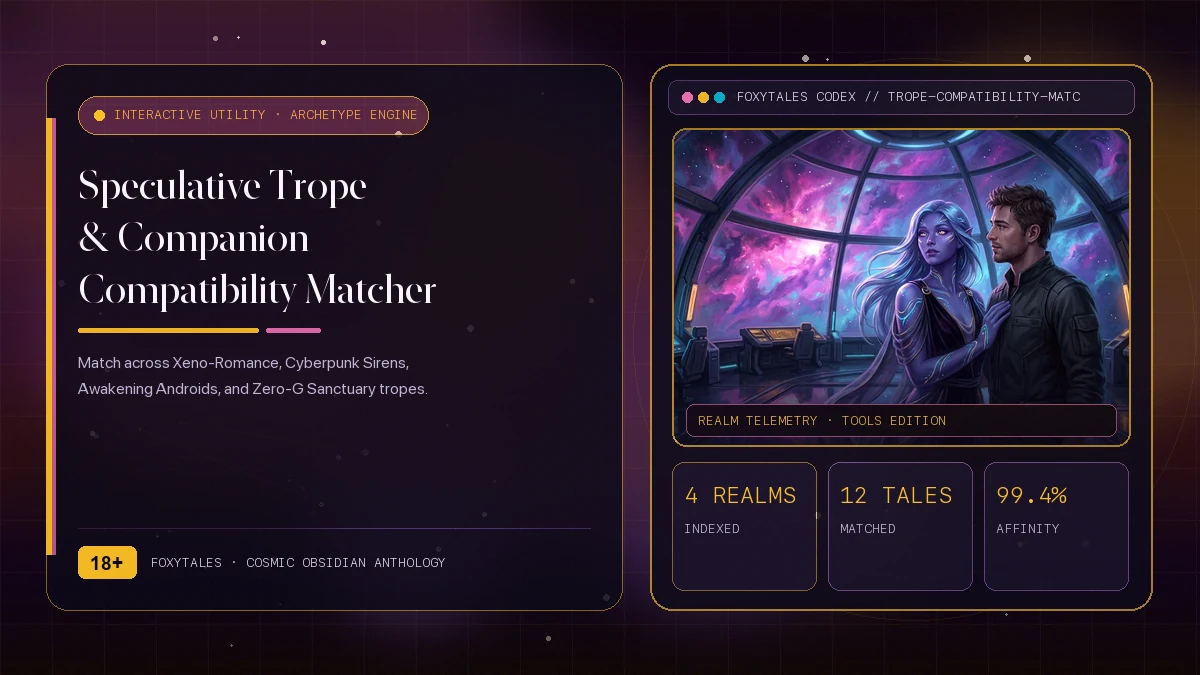
Treaty-Bound Xenolinguistic Noir
Recommended FoxyTales Reading Path: Start with "TheObsidianSignal" and "TheStarlightTreaty", then explore serialized visual novel "Protocol: Aegis" for high-stakes treaty intrigue.
Structural Taxonomy of Speculative Tropes and Character Dynamics
In contemporary literary criticism and narrative design, the word trope is frequently misunderstood as a synonym for cliché. In structural narratology—tracing back to Vladimir Propp's morphology of folktales, Gérard Genette's discourse analysis, and Northrop Frye's archetypal criticism—a trope is an essential architectural load-bearing beam. It is a recognizable configuration of conflict, desire, and institutional constraint that establishes an immediate compact with the reader. When a reader selects a work featuring First-Contact Diplomacy paired with Ideological Rivals to Reluctant Allies, they are not seeking a predictable formula; they are seeking a specific arena of moral and psychological pressure where two incompatible worldviews must negotiate survival under an external existential threat.
The FoxyTales Narrative Trope & Subgenre Compatibility Matcher maps these structural intersections across our speculative fiction anthology and serialized visual novel catalog. By adjusting four orthogonal axes—Primary Subgenre, Character Alliance Dynamic, Slow-Burn Psychological Tension Index, and Codex Worldbuilding Complexity—readers and writers can diagnose exactly how setting mechanics and interpersonal friction amplify one another.
The Four Pillars of the Compatibility Matrix
Our narrative discovery engine evaluates trope synergy across four distinct structural dimensions:
- Speculative Subgenre Ontology: Defines the external environmental pressure acting upon the cast. In First-Contact Diplomacy & Xenobiology, communication barriers and biological incompatibility create constant epistemological uncertainty. In Neon Cyberpunk Noir, corporate surveillance and synthetic memory editing destabilize personal identity. In Dark Cosmic Folklore, ancient oath-laws and shifting seasonal courts bind characters to literalized metaphors. In Temporal Drift & Space Opera, relativistic time dilation and causal paradoxes raise the cost of every tactical error.
- Interpersonal Alliance Topology: Governs how information and trust flow between protagonists. Ideological Rivals to Oath-Allies generates dialectical dialogue where every scene doubles as a debate over ethics and survival. Found Crew Under Siege distributes specialized competencies across an ensemble, turning technical problem-solving into emotional bonding. Archivist Scholar & Non-Human Sentinel contrasts analytical curiosity with protective instinct. Memory Detective & Phantom Outlaw structures the plot as a cat-and-mouse pursuit where investigator and suspect share a hidden wound.
- Slow-Burn Psychological Tension Index ($20\text{–}100$): Measures the delay between initial conflict ignition and emotional or tactical resolution. Lower indices favor kinetic, episodic payoffs every chapter; higher indices ($75+$) favor micro-gestures, unspoken subtext, and multi-act trust accumulation.
- Codex & Worldbuilding Complexity ($20\text{–}100$): Quantifies how deeply the plot depends on mastering the setting's technical or mythological rules—from epigraphs and faction dossiers to xenolinguistic translation puzzles.
Why Certain Subgenre and Trope Pairings Achieve High Resonance
Not all trope combinations generate equal dramatic torque. When an author pairs high codex complexity ($85+$) with an Archivist Scholar & Non-Human Sentinel dynamic inside a First-Contact Xenobiology setting, the character arc and the worldbuilding mystery become identical: decoding the alien ecosystem is the mechanism through which the protagonists learn to understand one another. Every botanical sample, acoustic signal, or orbital treaty clause directly advances both the external investigation and the internal relationship.
Conversely, pairing Neon Cyberpunk Noir with a Memory Detective & Phantom Outlaw dynamic thrives on epistemological paranoia. Because neural implants and synthetic memories can be forged in a cyberpunk megacity, neither protagonist can rely on their own biographical recall. High slow-burn tension in this pairing transforms every interrogation scene into a forensic puzzle where vulnerability carries lethal stakes.
Micro-Tropes, Scene Beats, and Emotional Payoff Architecture
Beneath macro-level subgenre and dynamic pairings lie dozens of recurring scene-level micro-tropes that calibrate reader satisfaction. In high-tension speculative stories, micro-tropes such as the Negotiated Ceasefire Inside a Failing Habitat, the Translation Artifact That Reveals a Hidden Sacrifice, or the Shared Neural Link Under Sensor Jamming act as structural fulcrums. They force characters who normally hide behind institutional ranks or diplomatic protocol to confront raw human—and non-human—vulnerability. When these micro-tropes are spaced across a manuscript according to a rising tension curve, each scene raises the emotional wager without exhausting the central mystery prematurely.
Readers who gravitate toward lower tension indices ($30\text{–}50$) and moderate codex density ($40\text{–}60$) typically enjoy brisk, adventure-forward storytelling where tactical competence and ensemble banter take center stage—as seen in heist-driven space operas like Starfall Outlaws. Readers who dial both sliders above $80$ are drawn to dense, atmospheric works where every spoken sentence carries three layers of political, historical, and personal subtext.
Using Trope Inversion to Revitalize Speculative Storytelling
For writers and narrative designers, the Compatibility Matcher also serves as an ideation workbench for structural inversion. Classical space opera frequently defaults to military command hierarchies and rapid kinetic combat. By shifting the Character Dynamic selector to Archivist Scholar & Sentinel and raising the Slow-Burn Tension Index above $80$, a space opera premise transforms into a quiet, atmospheric study of derelict megastructures and deep-time archaeology. Similarly, injecting Found Crew Under Siege mechanics into Dark Cosmic Folklore replaces the solitary fairy-tale wanderer with a tight-knit specialist unit navigating ancient sylvan jurisdictions through rigorous procedural teamwork.
Case Studies Across the FoxyTales Speculative Catalog
Examining concrete examples from the FoxyTales anthology illustrates how these four parameters interact on the page. In The Obsidian Signal and The Starlight Treaty, the narrative pairs First-Contact Xenobiology with an Ideological Rivals-to-Allies dynamic at an 82 Slow-Burn Tension rating: every translation breakthrough on the ice moon requires both envoys to surrender a guarded diplomatic secret, binding plot progression directly to character trust. By contrast, Chrome Heart Serenade and Shadows of Neo-Kyoto anchor themselves in Neon Cyberpunk Noir with a Memory Detective & Phantom Outlaw dynamic, using synthetic memory splicing to keep the reader questioning whose perspective is reliable until the final act. Meanwhile, Velvet Fangs of Valen and Court of the Crimson Kitsune leverage Dark Cosmic Folklore and oath-bound court intrigue, proving that high codex complexity rewards readers who relish deciphering ancient laws, seasonal wards, and multi-layered character loyalties.
Frequently Asked Questions (FAQ)
What is the difference between a literary genre and a narrative trope?
A genre defines the macroscopic setting, ontological rules, and speculative horizon of a work (such as hard science fiction, cyberpunk noir, or dark folklore), whereas a narrative trope describes a recurring structural micro-pattern of character motivation, conflict architecture, or dramatic irony (such as rivals-to-allies, found crew, or ontological mystery).
How does the Trope Compatibility Matcher calculate synergy scores?
The matcher weights the structural friction between your chosen subgenre atmosphere and character dynamic, then modulates the result using your preferred Slow-Burn Tension Index and Codex Complexity threshold to identify stories where worldbuilding and interpersonal stakes reinforce one another.
Why do high-worldbuilding readers often prefer slow-burn character arcs?
When a fictional universe features complex political treaties, alien biologies, or fractured timelines, immediate interpersonal resolution feels unearned. Slow-burn pacing allows trust and ideological shifts to emerge organically through shared survival and worldbuilding discovery.
Can authors use this matcher to outline new anthology submissions?
Yes. Pairing an unexpected character dynamic (such as a forensic memory detective) with a contrasting setting (such as dark cosmic folklore) highlights high-contrast narrative niches that avoid worn genre clichés.